Your brain is not fixed. That’s not a motivational slogan, it’s neuroscience. The same plasticity that lets you learn a new skill or build a habit also means you can train specific patterns of brain activity, deliberately and measurably. Neurofeedback is built on exactly that principle. And now, with clinician-supervised remote delivery, you can do it from your home.
This is what the evidence actually shows.
What neurofeedback is, and what it isn’t
Neurofeedback is a form of EEG biofeedback. Sensors placed on your scalp read your brainwave activity in real time. That data feeds into software that gives you continuous audio or visual feedback, a tone, a visual cue, a game responding to your brain state. When your brain produces the target pattern, the feedback rewards it. When it drifts, the feedback stops. Over dozens of sessions, your brain learns to self-regulate.
It’s a technique that enables individuals to regulate their brain activity in real time, and it has gained momentum as both a clinical tool and a method for cognitive and performance enhancement.
It is not a passive treatment. You’re not sitting with electrodes on your head waiting for something to happen. The training is active. Your brain is doing the work, and the feedback is the coach.
The brainwave frequencies that drive focus
Not all brain activity looks the same. The EEG records different frequency bands, delta (1–4 Hz), theta (4–8 Hz), alpha (8–12 Hz), sensorimotor rhythm or SMR (12–15 Hz), beta (13–30 Hz), and gamma (30–100 Hz), each representing a particular physiological function.
Focus and concentration are tied to specific bands. Beta and SMR are associated with active, engaged thinking. Alpha relates to relaxed, internalized attention, the state a skilled performer enters before executing under pressure. Theta in excess tends to indicate a wandering, unfocused mind.
Neurofeedback protocols for focus work by reinforcing the productive patterns, typically beta and SMR, while reducing the disruptive ones. The brain learns, through repetition, to stay in the zone longer and return to it faster when distracted.
What the research shows in healthy adults
Most people assume neurofeedback research applies only to clinical populations. That’s not accurate. A growing body of work examines its effects on healthy individuals looking to sharpen cognitive performance.
Alpha neurofeedback training shows a positive effect on alpha amplitudes in healthy participants, with evidence suggesting that increased alpha activity may enhance cognitive flexibility, including improvements in response time and reductions in cognitive stress compared to control groups.
SMR training has shown similar results for working memory. A randomized placebo-controlled study found that the SMR neurofeedback protocol improved working memory performance in healthy adults, with changes reflected in theta and beta activity at frontal regions and alpha at temporal regions.
The sports performance literature is particularly compelling because it studies high-functioning individuals with no clinical deficits, exactly the population that benefits from a brain wellness approach. Research has demonstrated that SMR-based neurofeedback improved golf putting performance in novice individuals and that its effects were sustained even after a follow-up period two weeks after the intervention. The field has seen rapid development, with eight high-quality neurofeedback studies published in 2023 and 2024 alone, underscoring the growing body of evidence behind its use for performance enhancement.
Does remote delivery actually work?
This is the right question, and the answer matters for anyone considering a program delivered at home.
A retrospective study of 593 participants assessed the efficacy of app-based remote neurofeedback training in improving brain health and cognitive performance. After an average of 53 sessions, between 57% and 78% of participants demonstrated significant improvement depending on the measure used, with large effect sizes across both adults and children.
Large effect sizes in research terms means the difference was substantial, not marginal. Effect sizes in neurofeedback research are typically moderate to strong, ranging from 0.5 to 0.8, and the results are often durable.
The key distinction in remote delivery is clinical oversight. A consumer EEG device running a software and a clinician-supervised remote program using a full QEEG brain map to personalize the protocol are not the same thing. The research showing strong results involves the latter. Personalized protocols, matched to an individual’s actual brainwave baseline, consistently outperform generic training.
What a supervised remote program actually looks like
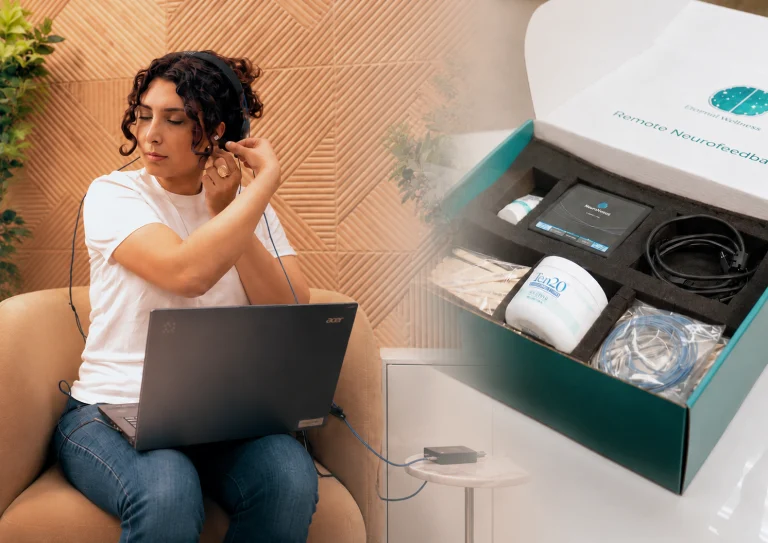
A well-designed remote neurofeedback mental wellness program starts before the first session. A quantitative EEG brain map (QEEG) captures a detailed picture of your brain’s baseline activity, which frequencies are dominant, which are deficient, and where. That map drives the protocol your clinician designs.
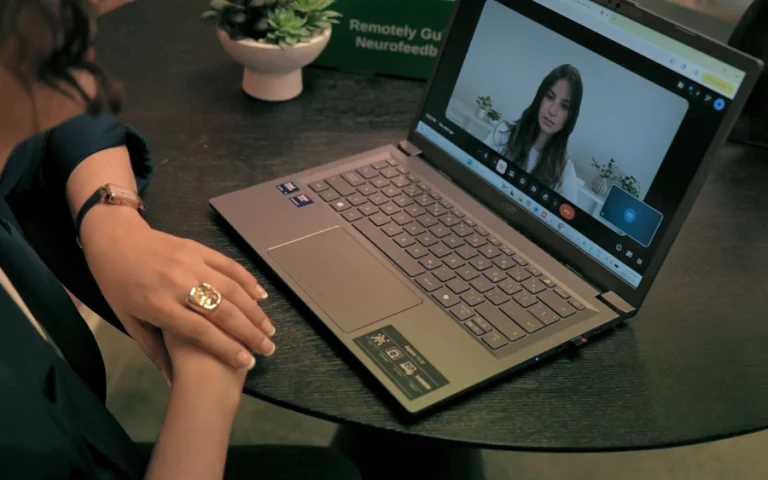
From there, the NFB device that you have at your home will be the key element. Sessions run 30–45 minutes, typically three to five times per week. You train. The software reads your brainwaves in real time. The feedback rewards your brain for hitting the target patterns. Your clinician monitors your data remotely, reviews your progress at regular intervals, and adjusts the protocol as your brain changes.
The logistics, devices, shipping, insurance, clinician reviews, are wrapped into a single package. No travel. No clinic waiting rooms. The same clinical-grade technology, in your home.
Who is this actually for?
The honest answer: anyone who wants to perform better mentally and is willing to put in the sessions. Executives managing cognitive load across a 10-hour workday. Students navigating high-stakes academic periods. Professionals in demanding creative or analytical roles. People who’ve noticed their concentration slipping and want a non-pharmaceutical, evidence-based response to it.
This is brain wellness, not brain treatment. The goal is optimization, sharper focus, faster return to concentration after distraction, and a brain that self-regulates more efficiently under real-world pressure. Neurofeedback has gained significant momentum as a tool for performance optimization, with applications expanding well beyond clinical populations into cognitive enhancement for athletes, students, and professionals.
The bottom line
The science is clear enough to act on. Neurofeedback trains specific brainwave patterns associated with sustained focus and concentration. It works in healthy people, not just clinical populations. Remote delivery with proper clinical supervision produces results comparable to in-clinic protocols. And the effect sizes are meaningful, not just statistically significant.
Your brain is trainable. Forty sessions from your living room, guided by a clinician who reviews your QEEG and adjusts your protocol, is a serious investment in what that brain does every day.
That’s what remote neurofeedback offers. Not a shortcut, a system.
Elumind’s Remote Neurofeedback Wellness Package includes 2 QEEG brain mapping sessions, 40 neurofeedback sessions, and 4 clinician reviews. Devices ship anywhere in Canada. Book your free consultation.